Peter Paul Rubens’ Narrative Paintings Turn Myth into Moving Scenes
Across seven paintings, Rubens uses motion, expression and telling details to make classical and religious stories legible at a glance.

Rubens makes a story feel as if it is still unfolding. Across paintings made between 1604 and 1639, he repeatedly places viewers at a turning point: a fall is underway, a rescue is imminent, or a confrontation has only just begun. His subjects come largely from classical myth, with a religious narrative among the later works. The lasting interest lies in how he builds time into a still image, using gestures and scattered objects to point both backward to what happened and forward to what comes next.
Several paintings draw on Ovid’s Metamorphoses. In Rubens’ hands, these stories aren’t simply illustrated. Figures twist across the canvas, expressions direct attention, and secondary details fill in parts of the plot that the central action leaves out. That approach gives the scenes energy while helping viewers follow a story crowded with characters and consequences.

Disaster shown in motion
The Fall of Phaeton, begun around 1604 and apparently revised over the next three or four years, presents a loss of control on a cosmic scale. Phaeton tumbles from the sun chariot, while the Hours who accompany him are caught in the same upheaval. Some wear butterfly wings, a distinctive detail among the figures flung into disorder. The scene’s crowded movement makes it hard to settle on a single point of focus; the eye travels through the falling bodies and unstable chariot, echoing the collapse of order in the story.
Rubens also gives the viewer a glimpse of what follows. At the lower right, the earth burns as a consequence of Phaeton’s folly. This small area works as a visual preview: the danger extends beyond the figures in the sky and reaches the world below. The painting’s force comes partly from this compression of cause and consequence into one view.
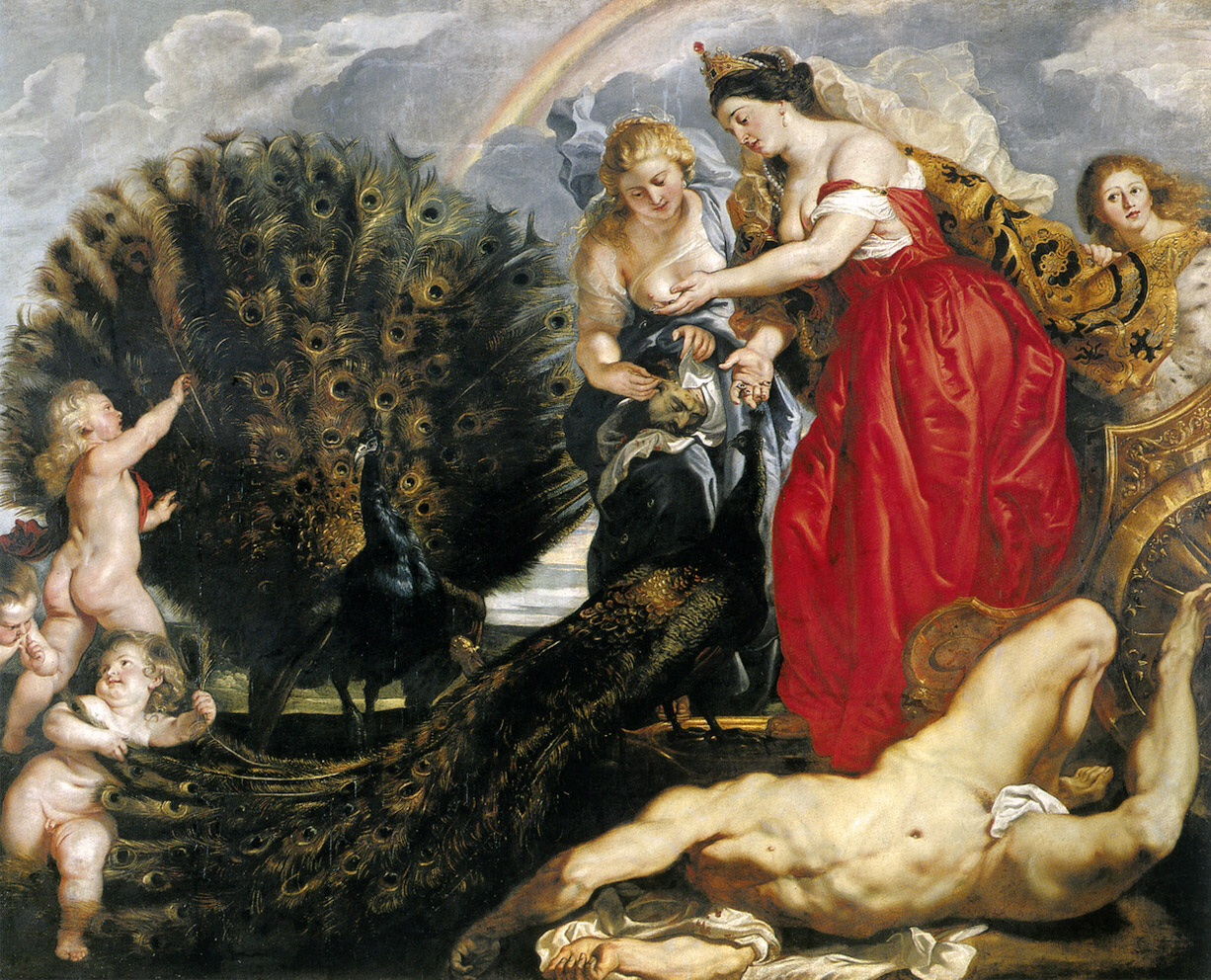
Juno and Argus, painted around 1611, chooses a quieter but no less disturbing moment from the story of Io. Juno receives eyes taken from the severed head of Argus and places them on her peacocks’ tail feathers. Argus’ headless body lies twisted in the foreground, a reminder of the violence that has just taken place. The scene’s arrangement links the act of transformation to its cost: the peacock’s decorated feathers and the corpse occupy the same narrative space.
There’s also a knowing visual joke. Juno’s left hand appears to rest beneath the breasts of the woman behind her. It interrupts the solemnity of the scene with a pointed ambiguity, showing how Rubens could work humor into an otherwise grim story.

In Perseus and Andromeda, from around 1622, the central danger has passed. Andromeda stands unchained, while Perseus receives laurels as the victor and takes her hand as his reward. His winged sandals and polished shield identify him; the shield still reflects the face and snake hair of Medusa. Nearby, a putto carries Hades’ helmet of invisibility, while other putti suggest the marriage to come.
Rubens brings in Pegasus on the right, drawing on a different telling of the myth. At the bottom edge, the dead Cetus lies with its mouth open. These details give the viewer a compact account of what has happened and what is expected next, even as the painting pauses after the fight rather than at its most violent moment.

Small details carry the plot
The Fall of Icarus dates to 1636 and is an initial oil sketch, presumed to have been developed into a finished painting by Rubens’ apprentice Jacob Peter Gowy. Icarus drops past Daedalus with his wings in tatters, arms lifted as if he could still keep himself aloft. His open mouth and wide eyes register shock and fear. Above him, Daedalus remains in flight, his wings intact, looking toward his son.
The setting expands the story beyond the two figures. Far below, a bay, a fortified town and the edge of the sea establish the height of the fall and anticipate where Icarus will land. The sketch’s compact scale doesn’t reduce the drama; the opposing directions of father and son make their separation immediately clear.

In The Rape of Proserpina (1636–38), Rubens combines elements of Ovid’s account into a scene driven to the right. Pluto struggles to lift Proserpina into his chariot as Minerva tries to stop him. Pluto’s bulging eyes turn toward Minerva, making his expression part of the confrontation. Two winged Cupids prepare to urge the black horses onward once the pair are inside.
The scattered flower basket below the chariot points back to Proserpina’s interrupted activity. Like the burning earth in The Fall of Phaeton, it gives the viewer a clue to events beyond the central action. Rubens’ composition holds several stages of the story together: the abduction, resistance and the moment just before the chariot moves.
The Rape of Hippodame (Lapiths and Centaurs), also from 1636–38, turns a wedding feast into a broad melee. On the right, Eurytus tries to carry off Hippodame while Theseus prepares to rescue her. On the left, Lapiths attack with weapons; farther back, another centaur attempts to abduct a woman. The clash moves across the canvas rather than staying with a single pair of figures.
Faces and objects help distinguish the struggle. The expression of the Lapith holding a sword on the left sharpens the scene’s urgency, while food and furniture tumble at the lower left, evidence of the feast disrupted. These fragments make the setting legible even amid the crowd.

A tense moment before the threat
Susanna and the Elders (1636–39), one of Rubens’ religious narratives from his later years, shifts the focus from myth to a private encounter. Susanna sits on her clothing and tries to cover herself with a dark cloak as two elders climb over a low wall. The scene stops before they make their proposition; they may not yet have formed the blackmail that follows in the story.
A small dog runs toward the men, perhaps alerting Susanna that she has been seen. Objects at the lower left refer to her interrupted toilet, giving the setting a sense of ordinary activity abruptly disturbed. That choice of an early moment changes the scene’s tension: the viewer sees the threat approaching while Susanna is still reacting to its arrival.
Across these works, Rubens uses bodily movement, expressions and objects to make time visible. A flower basket, a broken feast or a distant burning earth can carry as much narrative weight as the central figures. That’s the practical key to reading these paintings: follow not only the main action, but also the details that tell you what came before and what may happen next.