Egypt in Art: From Ancient Funerary Paintings to 19th-Century Landscapes
Egypt’s art spans narrative burial paintings, Roman-era portraits and 19th-century views shaped by travel, archaeology and artistic imagination.

Egypt appears in these works as both a place artists could study firsthand and a civilisation Europeans reconstructed from ancient remains and biblical stories. The contrast runs from paintings made for burial more than three thousand years ago to 19th-century watercolours and oil paintings of the Nile, Cairo and Giza. Together, they show how artistic depictions of Egypt shifted with access to the country—and how observation and imagination often shared the same canvas.
Stories for the afterlife
By about 1300 BCE, Egyptian artists were using images to tell stories, including in the Books of the Dead placed with royal burials. One example, now at the British Museum, lays out a judgment scene in two tiers. Its lower register guides the viewer through the proceedings, while the gods in the upper register look on.

In The Weighing of the Heart from the Book of the Dead of Ani, Ani and his wife Tutu approach an assembly of gods. Anubis weighs Ani’s heart against the feather of Maat. If the heart is heavier, Ani cannot enter heaven. The scene’s supporting cast makes the judgment feel like a complete narrative: Renenutet, Meshkenet and Shay observe, as does Ani’s ba, represented as a bird. At the right, the monster Ammut waits to devour his soul if the judgment goes against him, while Thoth records the result.
Portraits made for burial
Centuries later, Roman communities in Egypt produced a different kind of funerary image: portraits painted on wooden panels and fitted to mummies. Many have been recovered from burial sites in the Nile Valley, including Fayum, Antinoöpolis and Thebes. Their close attention to individual faces gives these works an immediacy quite unlike the formal procession of figures in the Book of the Dead.

Known as The European, this portrait was made between 80 and 200 CE with encaustic paint, a wax-based medium. The painter used tightly packed strokes to shape the woman’s features, then scraped away wax to form her eyelashes against the dark ground. Small squares of gold leaf decorate her neck. The cedar panel was trimmed to fit over the face of the mummy for burial. The artist is thought to have been among the professional portrait painters serving Romans in Antinoöpolis.
Egypt imagined from Europe
For artists in northern Europe, Egyptian history also offered a setting for biblical scenes. These paintings could draw on archaeological knowledge while rearranging real places and monuments to serve a story. Edward Poynter’s large-scale Israel in Egypt is one such example. Painted in 1867, its crowded panorama depicts the Israelites in bondage and combines details from several sites into a single dramatic view.

Viewers praised the painting’s archaeological detail, but scholars of the period noted that Poynter had brought together features associated with the temples at Thebes, Edfu and Philae, the Great Pyramid at Giza and Thebes’ limestone cliffs. That mixture is revealing: the painting aims to evoke Egypt rather than document one location accurately.

José María Avrial’s Pharaoh’s Daughter Rescuing Moses from the Nile (1862) makes a related choice through scale. The central event—a small group of figures presenting the infant Moses to Pharaoh’s daughter—sits beneath monumental architecture. Miriam watches from the lower left. The story is clear, but the buildings claim much of the viewer’s attention.
Travel changes the view
Artists who visited Egypt could work from the places themselves. Richard Dadd travelled up the Nile in December 1842 and January 1843 with his patron, recording archaeological sites before his later mental illness. His watercolour of Cairo’s Tombs of the Khalifs has the character of a travel illustration, the sort of view suited to an account of the journey.

Thomas Seddon, a young Pre-Raphaelite landscape painter, also travelled through Palestine and Egypt. His View on the Nile near Cairo, dated 1855, has uncertain timing: it may have been made before his journey to Jerusalem in May 1854, or during his second Cairo visit in autumn 1856.

The Pyramids at Gizeh, believed to date from autumn 1856, was Seddon’s last painting. A second version presents the same view in richer sunset colours. Seddon died in Cairo on 23 November 1856, aged thirty-five, after contracting dysentery. His paintings were shown at a memorial exhibition the following year, where critic John Ruskin commended their “perfect artistical skill” and “topographical accuracy”. The pairing of those qualities points to what mattered in these travel pictures: a composed image that could still persuade viewers of its close attention to place.
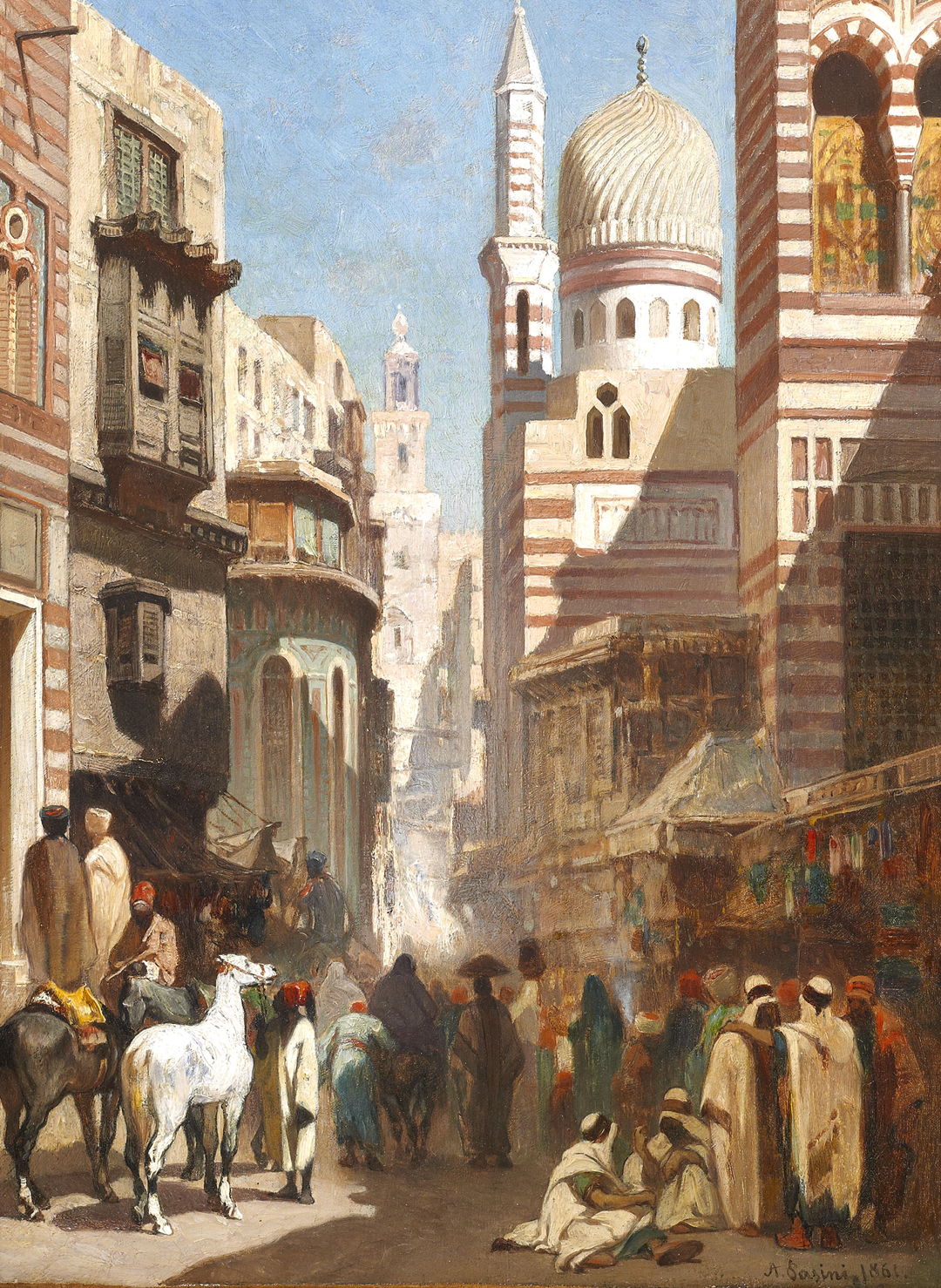
Alberto Pasini’s Al-Khudayri Street, Cairo (1861) brings the focus down from monuments to city life. Some accounts identify the Ibn Tulun mosque, its spiral minaret and Saladin’s fortress in the composition, though the view appears to combine inspiration from those buildings rather than record them faithfully. Market stalls and passers-by fill the street. Pasini leaves the figures’ faces unseen, making the scene feel busy without turning them into individual portraits.
Across the centuries, these images move between religious instruction, memorial portraiture, imagined history and travel observation. For today’s viewer, that shift is as interesting as the monuments themselves: even a painting made on location can be selective, while an imagined scene can reveal what its maker believed Egypt should look like.
===DONE===