How 19th-Century Artists Painted Egypt’s Monuments and Street Life
From the Memnon colossi to Cairo’s sunlit streets, European visitors recorded Egypt in works shaped by travel, studio studies and Orientalist conventions.
Egypt gave 19th-century European artists more than its ancient monuments. Their pictures also recorded agricultural work, markets, cemeteries and city streets, though they often framed these scenes through the era’s Orientalist tastes. Together, the works show how artists translated what they saw on visits into images for audiences far from the places depicted.
Ancient landmarks in changing light
By the latter half of the century, European visitors to Egypt had become more numerous. Some travelled beyond the cities to paint ancient remains, including the two statues known as the Colossi of Memnon at Al Bairat, near Luxor. The statues had been familiar since classical times, but their scale and setting made them especially compelling subjects for artists seeking dramatic views.

Gustav W. Seitz’s Egypt: the Statues of Memnon survives here as a colour lithograph made from his watercolour. Its atmospheric treatment makes the distant setting feel expansive, while the moon’s apparent size offers a clear example of the moon illusion: near the horizon, it can look larger than it does high in the sky.

Charles Vacher’s 1864 watercolour gives the same subject a different emphasis. The broad horizontal format lets the colour and surrounding landscape carry as much weight as the statues themselves. That choice makes the work read less like a study of isolated monuments and more like an account of their place in the terrain.

Albert Zimmermann’s oil painting turns attention to the effects of heat and distance. A haze softens the view, and a snake moving through the water adds a small, active detail to an otherwise monumental scene. Across these three interpretations, the statues remain recognizable, but atmosphere, colour and scale shape the viewer’s experience.
Work and spectacle in Gérôme’s Egypt
Jean-Léon Gérôme first visited Egypt in 1856 and became a prolific painter of Orientalist subjects early in his career. His works range from scenes of daily labour to staged interiors and marketplaces, giving them a wider subject range than the familiar image of the exotic dance or bazaar.

The Grain Threshers, Egypt (1859) depicts a traditional method of separating grain, still widely used at the time. The subject connects the painting to practical work and agricultural routines, rather than concentrating solely on the ancient past. For contemporary viewers, that kind of scene could make an unfamiliar setting legible through an activity with a clear purpose.
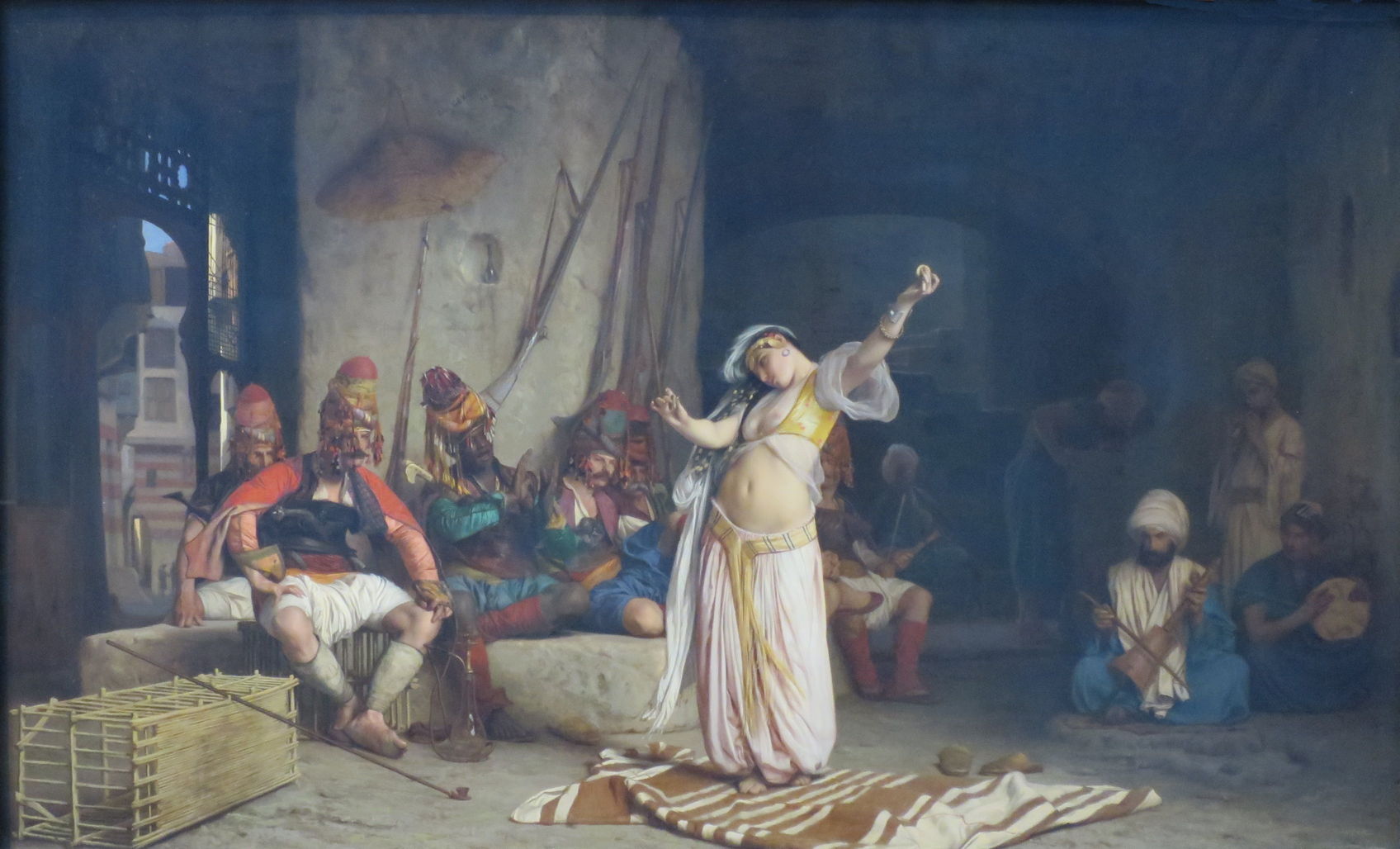
His Dance of the Almeh (1863) sits closer to the conventional Orientalist scene. The subject may feel familiar now, but European audiences had access to relatively few images of many places represented in such paintings, including sites few Europeans had visited. That scarcity helps explain their appeal; it doesn’t remove the distance between the painted scene and the culture being shown.

The Carpet Merchant (1887) makes its display of textiles feel grand by placing them in an everyday setting. The contrast gives the carpets visual force without separating them from the marketplace around them. A white-robed figure stands in deep shadow just right of centre, adding a note of uncertainty to a composition otherwise organized around the vivid goods on display.
Travel sketches, studio paintings and city views
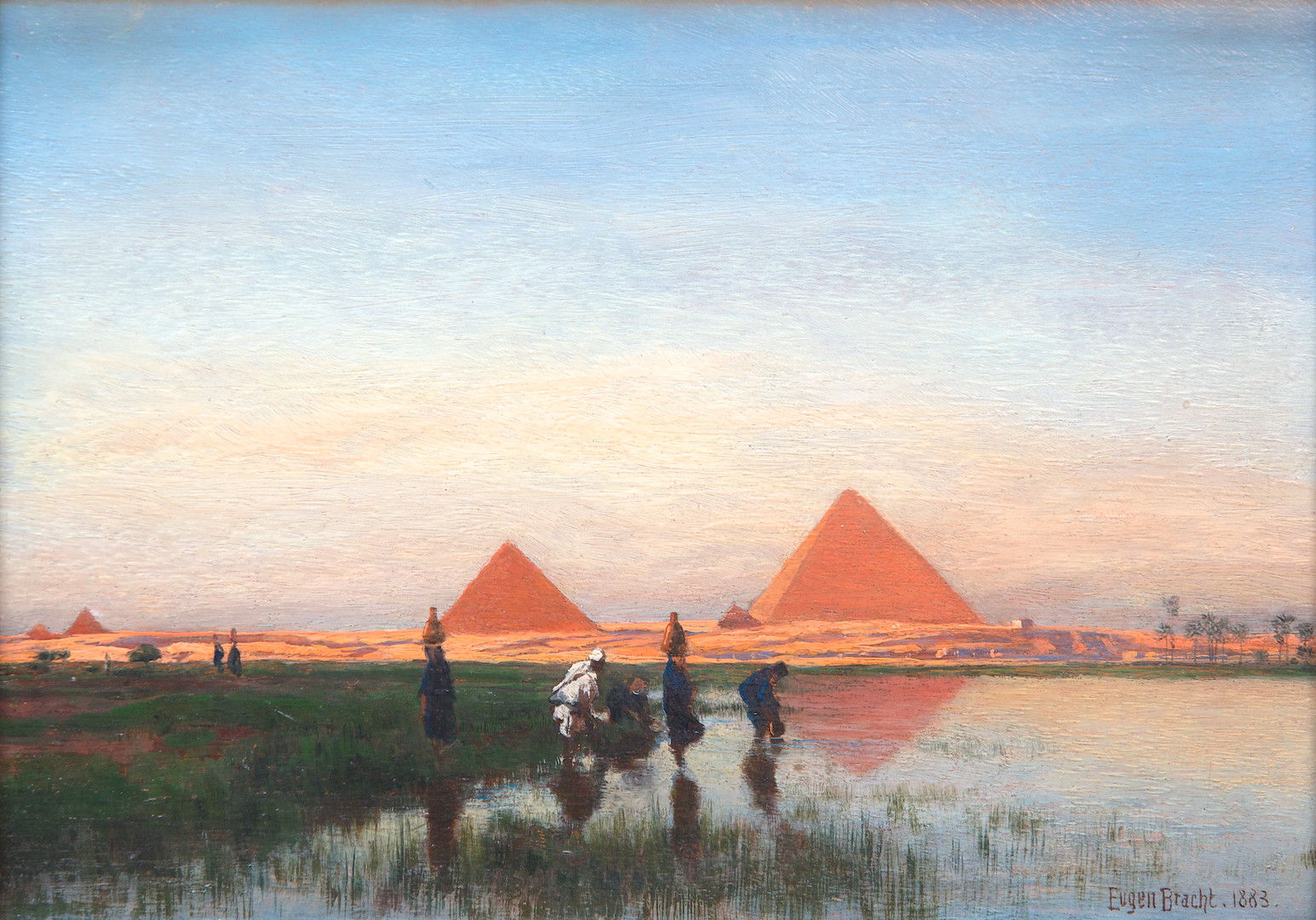
Some artists worked directly from studies made while travelling, then developed those observations into finished paintings back in Europe. Eugen Bracht followed this approach after visiting Egypt, Syria and Palestine in 1880–81, producing oil paintings from sketches and studies made during the trip.
Painted in Berlin in 1883, Memory of Gizeh shows how a small panel could preserve the colour and character of a travelled scene after the artist had returned home. Its title makes that process explicit: this is a recollection shaped into a finished work, rather than a painting made on location.

Hans Andersen Brendekilde was best known for Naturalist paintings of rural Denmark. During travels across Europe, Egypt, Syria and Palestine in 1889–90, he painted The Graves of the Apostles Jacob and Zacharias near Cairo (1889–91). The view places the cemetery on a hill above the city, with the Pyramids visible along the skyline. Religious landmarks, burial grounds and the distant urban edge share the same composition.
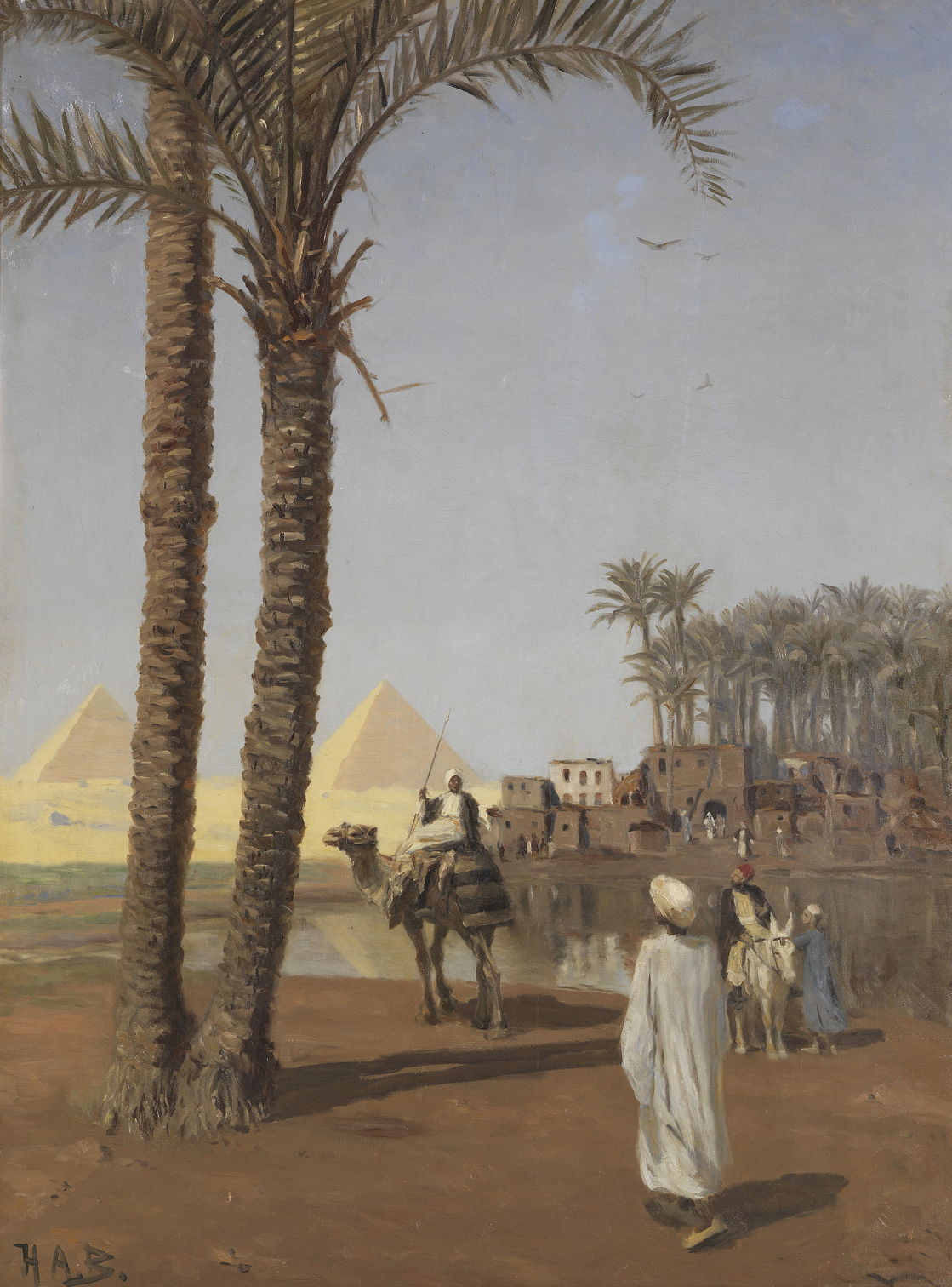
His Oriental Scene with the Pyramids of Giza in the Background, probably painted around 1890, uses the famous monuments as a distant marker within a broader scene. Their presence anchors the image geographically, while the foreground supplies the activity and detail. The Pyramids were already among Egypt’s most recognizable sights, but here they form part of a lived setting rather than the sole subject.

Arthur Streeton brought a different background to the subject. An Australian Impressionist, he travelled from Sydney to London in 1897 and stopped in Cairo and Naples along the way. His oil sketch, Cairo Street (Mosque, Sultan Hassan), reduces the city view to a compact study of architecture and intense sunlight. The variety across these artists is the lasting interest: Egypt appears as ancient site, working environment, marketplace and bright urban street, filtered through both direct observation and the conventions of European art.