Orestes and the Furies in Art: From Classical Terror to Sargent’s Swarm
Painters recast Orestes’ torment across a century, shifting the Furies from mythic pursuers into visions of guilt, memory and fear.
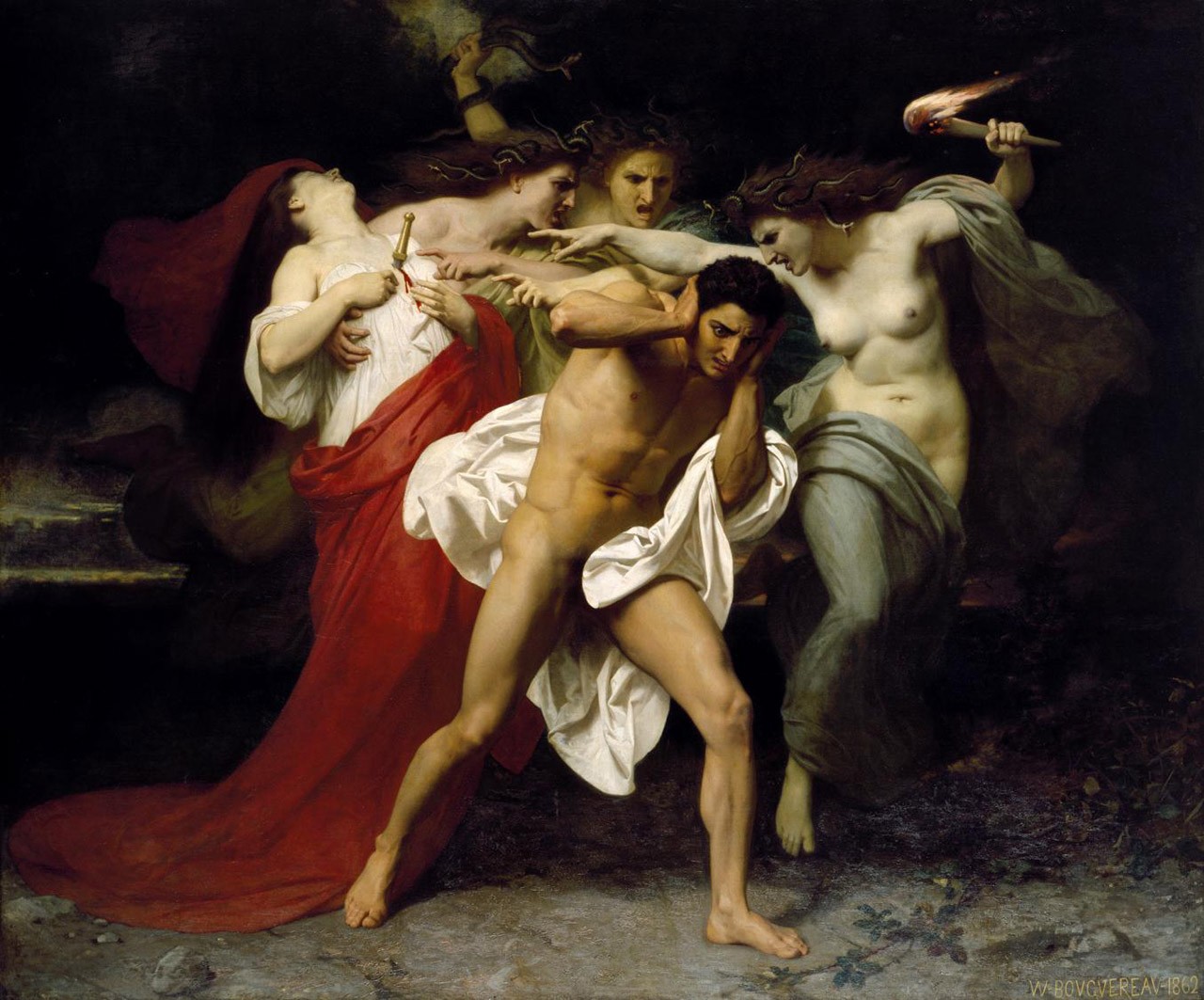
The Furies give painters a way to make Orestes’ guilt visible. In Aeschylus’ The Eumenides, the final play in the trilogy about him, they pursue and torment him after he kills his mother, Clytemnestra, and her lover, Aegisthus. Across the paintings that followed, artists turned that pursuit into different kinds of scene: a private nightmare, a crowded account of family violence, or a full-scale assault that leaves Orestes with nowhere to go.
That variety matters. The Furies are not simply repeated as a set of frightening figures. Each painter changes the balance between the hunted man, the dead, and the supernatural forces surrounding them. The results trace how artists made an ancient story legible through composition and mood.

Louis Lafitte’s 1790 drawing places the myth inside a moment of apparent rest. Orestes lies on a couch, but sleep offers no refuge: four Furies close in around him. One, carrying a dagger, looms directly above. To the right, two winged figures bear the spirit of Clytemnestra. The scene’s force comes from that collision between a quiet domestic setting and an invasion by the dead. The violence has followed Orestes into the place where he should be able to recover.

Philippe-Auguste Hennequin’s The Remorse of Orestes (1800) expands the private torment into a dense, overlapping drama. Orestes holds the viewer’s attention at the left, his right arm around a woman the source identifies as probably his sister Electra. Around them, spirits and Furies crowd the canvas. Clytemnestra’s body lies on the floor; Agamemnon may also be among the figures. Arms reach in from multiple directions, gripping and pulling at the living and the dead.
That crowded arrangement lets Hennequin suggest several parts of the family story at once. The viewer has to read bodies and gestures rather than follow one clear sequence of action. The Furies become part of a wider field of memory and violence, with Orestes physically caught among the people and consequences bound to his act.

By around 1852, Carl Rahl brought the pursuit closer to the play’s stark confrontation. Three women attack Orestes with burning brands and daggers. Small snakes twist through their hair, linking their appearance to classical descriptions that make the Furies resemble Medusa. Their weapons and expressions make the threat immediate: this is not only a vision of guilt but a physical chase rendered as mythic violence.
William-Adolphe Bouguereau’s 1862 painting became the best-known version of the subject. Three Gorgonic Furies wail at Orestes while carrying Clytemnestra’s murdered body, with the dagger still lodged in her chest. The image binds the pursuit directly to the killing: the weapon, the corpse and the pursuer all appear together. Bouguereau makes remorse visible through confrontation, giving Orestes no distance from what he has done.

Gustave Moreau takes a more elusive route in Orestes and the Erinyes, painted around 1891 and also known as Orestes and the Furies. Orestes leans in the foreground of an ornate temple, still holding the bloodied sword. Above him stand three figures that look saintly rather than monstrous. They may represent the dead haunting him, while snakes uncoil near their feet and retain a link to the familiar imagery of the Furies.
The setting adds another layer. Its decoration draws on cultures across the eastern Mediterranean and Middle East, reaching as far as India. That mix makes the painting’s visual language difficult to reduce to a single source. Moreau’s version has received less recognition than his earlier, successful paintings of Salome, but its unusual combination of sacred-looking figures, snakes and elaborate ornament leaves room for closer study.

Franz von Stuck’s 1905 Orestes and the Erinyes rearranges figures from Bouguereau’s composition, turning the pursuit into a scene of motion. The Furies tumble and spin through space as Orestes tries to flee. Their movement makes the torment feel unstable: the figures do not hold a fixed position around him but seem to sweep through the space he is trying to escape.
John Singer Sargent’s late work brings the chase to its largest scale among these paintings. Its dozens of pursuers make the image feel less like a single encounter than a world closing in.

Sargent began Orestes Pursued by the Furies in 1922 and completed it in 1925, shortly before his death. Across the large canvas, a naked Orestes cowers as he runs from at least a dozen Furies. Their mask-like faces, swept-back blond hair, burning brands and handfuls of small snakes turn the chase into a relentless visual swarm. The gilded flames catch the eye, while the crowd’s repeated gestures keep attention trained on Orestes’ attempted escape.
One woman stands apart from that rushing mass. She wears a gilded crown, and a clean wound above her left breast marks her as Clytemnestra. Her stillness gives the scene a counterpoint: the Furies pursue Orestes, but the murdered mother remains the image around which the pursuit turns.

Across these works, the story’s enduring visual problem is how to show guilt as an external force. Lafitte makes it invade a moment of rest; Hennequin folds it into a crowded family history; Moreau turns it into an ornate, ambiguous vision. Sargent makes the answer emphatic: Orestes can run, but the dead and their avengers already fill the space ahead of him. That shift from intimate haunting to overwhelming pursuit is what gives the subject its staying power in painting.