Benjamin West’s European Career and the Limits of Modern History Painting
Benjamin West built his career in Britain, but his strongest work often came when he moved beyond the grand historical scenes he hoped to master.

Benjamin West spent most of his working life in Europe, yet his career kept circling a question that still matters to painters of historical events: how much can composition and drama do when a picture bends the facts? His best-known canvas, The Death of General Wolfe, helped make contemporary subjects look fit for monumental painting. West’s later work suggests he never fully understood what made that picture effective.
Born in Springfield, Pennsylvania, in 1738, West arrived in Europe in 1760 with support from wealthy Pennsylvanians who wanted him to develop as a painter. He had set his sights on history painting: large scenes drawn from the past, religion, or public life. Rome seemed an obvious place to study, but it offered him few painters working in the figurative and narrative tradition he wanted. He spent three years there, studying artists including Anton Raphael Mengs and Gavin Hamilton. Landscape might have offered a more fertile path; the Roman countryside was attracting painters interested in working outdoors. West, however, remained committed to narrative subjects.
On his way home in 1763, he stopped in London and stayed. There he met landscape painter Richard Wilson, then a student of Joshua Reynolds, whose portrait practice would make him one of Britain’s most successful painters. West attached himself to Reynolds, though neither Reynolds’s strengths nor the broader scene offered much guidance for the kind of historical work West hoped to make. Angelika Kauffmann, who arrived in London in 1765, might have been a more useful artistic connection.
A modern subject in a classical frame
The Death of General Wolfe (1770) remains West’s defining work. It depicts the British commander’s death during the brief battle near Quebec on 13 September 1759. Wolfe suffered three gunshot wounds and died soon after; the French commander, Louis-Joseph, Marquis de Montcalm, was also wounded and died the next morning. The British held their position, and French forces left Quebec. The event became a powerful symbol of sacrifice.

West organizes the central figures like a pietà, turning a battlefield death into an image of mourning with the emotional weight of a religious scene. The composition is clear and affecting. Its historical details are less persuasive: West included a Native American figure, although no First Nations Americans fought alongside the British in this battle. The discrepancy was recognized soon after the picture was finished.
West reportedly thought the painting’s departure from tradition lay in showing figures wearing contemporary clothes instead of togas. That choice mattered, but a recent event also demanded close attention to what viewers knew had happened. The picture’s achievement was its treatment of a contemporary subject as a grand historical scene. Its weakness was assuming that dramatic arrangement could excuse an invented detail.
King George III appointed West royal historical painter after taking an interest in his work. The post gave him financial security, but the king preferred classical subjects. West was consequently drawn into a long series of commissions in that vein, with less room to build on the promise of Wolfe. His own Pennsylvania had separated from British rule during the American War of Independence, while West continued painting in London.
Religious subjects and missed chances
West did attempt other contemporary scenes, including The Treaty of Penn with the Indians (1771–72) and The Battle of La Hogue (1778), but their compositions were less successful. Religious painting gave him a more reliable outlet. In Isaac’s Servant Tying the Bracelet on Rebecca’s Arm (1775), a small cast of characters makes the narrative easy to read.

The scene comes from the story of Eliezer, sent by Abraham to find a wife for Isaac. At a well, Rebecca offers water to Eliezer and his camels. He recognizes her as the woman he has been seeking and gives her bracelets and a nose ring as tokens of the match. West keeps the action focused on the two people, while a distinctly unimpressed camel adds a dry note of humor.
Another contemporary event gave West a subject with personal resonance. In 1778, William Pitt, Earl of Chatham, collapsed while speaking in the House of Lords and died soon afterward. Chatham had helped shape Britain’s success in the Seven Years’ War and opposed American independence. West, an American expatriate who had spent fifteen years in Britain and depended on its king for patronage, painted the event.

West was soon eclipsed by John Singleton Copley, a former protégé born in Boston in the same year as West. Copley moved to London in 1774 and painted a larger, more theatrical version of Chatham’s collapse a couple of years later. It quickly became the better-known image.

West’s strongest later work often appears when he shifts away from public spectacle. His 1786 sketch for St Paul Shaking off the Viper, an altarpiece commission for the chapel at the Royal Hospital for Seamen in Greenwich, shows the apostle surviving a snakebite on Malta. Exhibited at the Royal Academy in 1787, the composition places Paul above a crowd, with the snake still attached to his hand. Firelight supplies drama without crowding the central action.

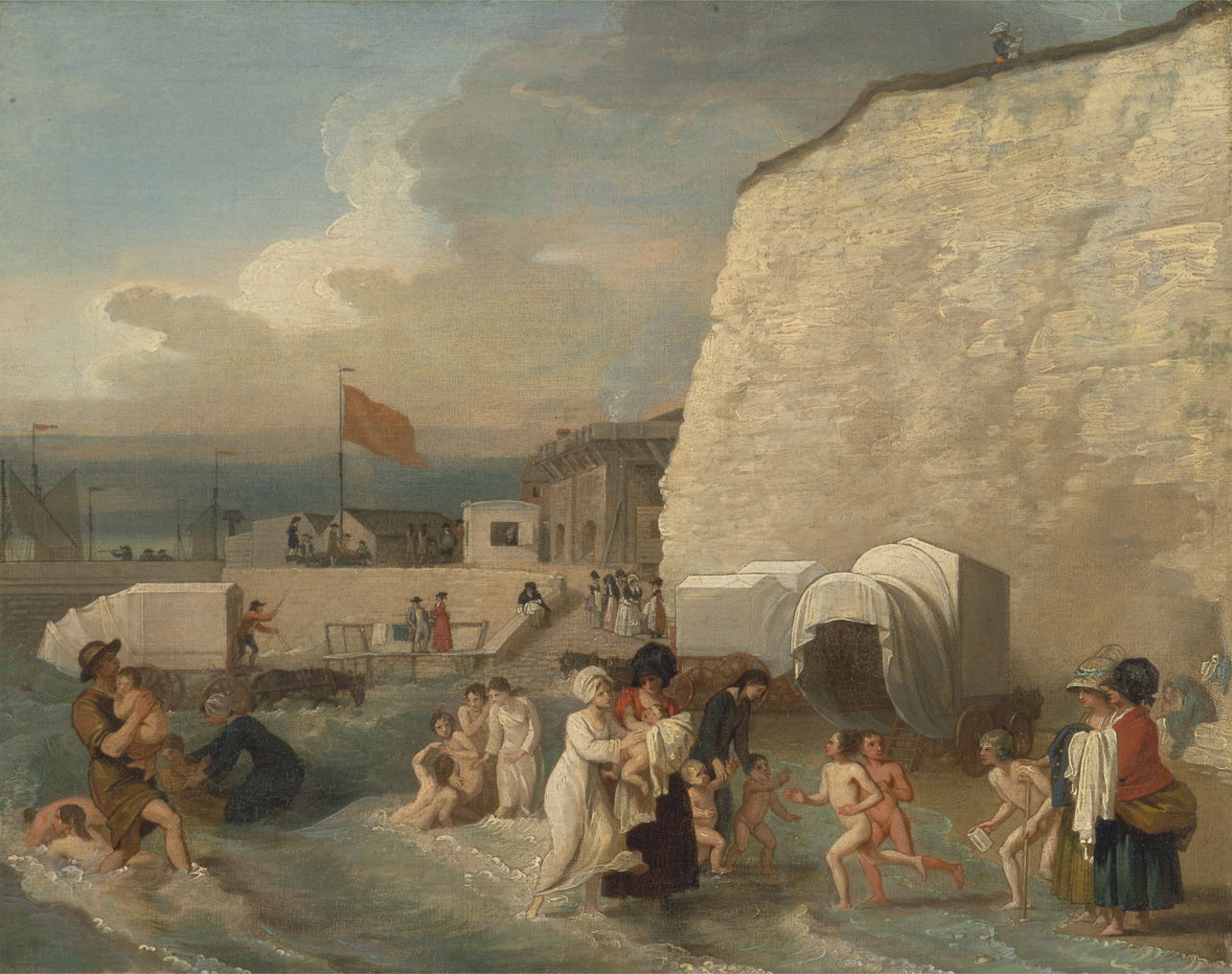
West also showed a feel for everyday settings in The Bathing Place at Ramsgate, painted around 1788 for a print collection. The small canvas records the novelty of sea bathing at the Kent resort, where visitors used covered, horse-drawn bathing machines to reach the water. He made relatively few landscapes, but this commission hints at what a broader range of subjects might have brought to his practice.
Ambition, spectacle, and a late-career setback
The Expulsion of Adam and Eve from Paradise (1791) shows West handling a familiar religious story with a relatively direct composition. Adam and Eve, covered in fur, are driven from Eden by the Archangel Michael beneath a flaming sword. A serpent crawls away. West adds a lion attacking horses and an eagle attacking another large bird, making the expulsion’s loss of harmony visible through violence among animals. The large canvas belonged to a planned series for the Royal Chapel at Windsor, a project that was never completed.

A small mythological panel, Eagle Bringing the Cup to Psyche (around 1802), draws on Apuleius’s The Golden Ass. Psyche has been sent to collect water from the source of the Styx and Cocytus, high on a cliff guarded by dragons. When she loses hope, Jupiter sends his eagle to drive them back and retrieve the water. The episode offered West a compact, legible scene rather than the crowded public drama that had so often challenged him.

West returned to contemporary history with The Death of Nelson, completed in 1806, a year after the admiral died. The picture stages Nelson’s death on the quarterdeck where he was wounded, but doesn’t accurately show where he died. Its theatrical arrangement weakens the scene, much as the Wolfe painting’s clear structure had once strengthened it. Public interest carried the work: shown in West’s studio, it reportedly drew 30,000 visitors in just over a month. After West’s death, the Royal Naval Hospital at Greenwich declined the painting. Arthur William Devis’s rival version from 1807 became the more popular image.
West is also remembered for Benjamin Franklin Drawing Electricity from the Sky, painted around 1816. The portrait turns Franklin’s famous electrical experiment into an allegorical scene, closer to romantic fantasy than a literal record.

West died in London on 11 March 1820, while serving as president of the Royal Academy. He was buried in St Paul’s Cathedral, near the remains of Reynolds and J. M. W. Turner. “American-born British painter” is a useful description of a career shaped by both sides of the Atlantic. West’s legacy rests on a striking tension: he helped widen the subject matter of history painting, but his most persuasive work came when his stories stayed clear, his compositions stayed focused, and the details held up.