Pokémon Happy Meals Return Nov. 10 With 15 Toys, Trading Cards and a QR Code Game
McDonald’s brings back Pokémon Happy Meals with 15 toy designs, collectible cards and a QR code game. The items are available while supplies last.

The main draw in McDonald’s returning Pokémon Happy Meals is the collectible set: 15 character toys, 15 matching box designs and cards that may make the meals hard to find once the offer begins. The meals arrive at participating US restaurants on Nov. 10, with one toy and two cards included in each. McDonald’s says the offer runs while supplies last, so availability will depend on local stock.

The menu choices follow the usual Happy Meal format: a hamburger or a four- or six-piece Chicken McNuggets meal, with kid-sized fries, apple slices and a beverage. The Pokémon items are the extra draw, rather than a change to what comes in the meal itself.

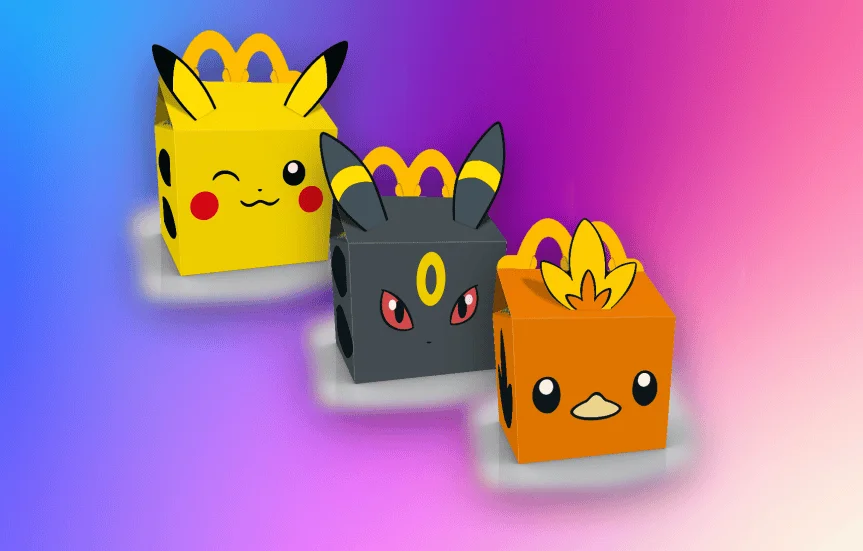
Each toy represents one of 15 Pokémon: Bulbasaur, Charmander, Eevee, Espurr, Minccino, Munchlax, Pikachu, Piplup, Rowlet, Sobble, Sprigatito, Squirtle, Torchic, Umbreon and Weedle. The figures are designed around the Happy Meal box. They have squared-off shapes and Golden Arches handles, giving the character toys a shared form instead of making them conventional standalone figurines.

There are also 15 box designs, one for each character. That gives collectors two visual variations to look for: the toy and its corresponding meal box. It’s a small distinction, but it makes the packaging part of the collectible set too. The source material identifies the characters and box designs, but doesn’t specify whether customers can choose a particular toy or card combination.

A QR code adds a digital activity
Every box includes a QR code that opens a digital game. Players search for the 15 Pokémon toys hidden across a virtual classroom and playground. The activity extends the set beyond the physical figures, though it depends on scanning the code and playing on a compatible device. No additional details are provided about the game’s features or how long it will be available.
That mix of physical collectibles and a simple digital activity gives the offer more to do than opening a toy, while keeping the core experience familiar. The QR code points to a specific task—finding the characters in two virtual locations—rather than a broader game whose scope or mechanics are unclear.
Demand could shape availability
The practical question is how long restaurants will have the toys and cards. Pokémon collectibles have attracted fast demand in past meal promotions, and the article reports that the US offer will last only while stock remains. That makes local availability an open variable: the start date is clear, but there’s no stated end date or information about how many items each restaurant will receive.

A similar offer in Japan in August 2025 ran into problems when people bought meals to get the included cards, then discarded the food. McDonald’s Japan responded by limiting each group to three Happy Meals. After that limit was introduced, meals came with toys but not cards, according to IGN’s report.

That earlier response gives some context for why the card allocation may matter as much as the toy lineup. The US offer has two cards per meal, but the source does not say whether McDonald’s will set purchase limits or adjust what restaurants hand out if supplies run short. Those details could affect how easy it is for families and collectors to get a complete set.
McDonald’s had been asked whether US restaurants would apply limits similar to the ones used in Japan; no answer was included in the source. Until the company clarifies that point, buyers can count on the Nov. 10 start and the listed contents, but not on a particular character being available or on a fixed supply period.
For families, the meal remains a standard food order with a toy, cards and an optional QR code activity. For collectors, the combination of 15 characters, 15 boxes and unpredictable stock makes timing the main consideration. The useful details to watch are whether restaurants set per-customer limits, whether card distribution changes, and how quickly local supplies run down.