GitOps Release Promotion Adds Control to Large Kubernetes Fleets
GitOps sync can reach hundreds of clusters quickly, but staged promotion adds the visibility and checks teams need to contain failures.
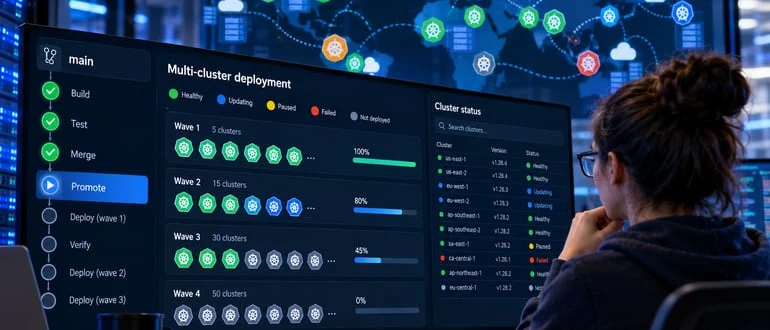
At fleet scale, the hard part of GitOps isn’t getting a configuration to every Kubernetes cluster. It’s deciding when that configuration is ready to move beyond the first few. A merge that once meant a routine update can become a fleet-wide release, leaving teams with little room to detect and contain a problem.

That gap is what release promotion addresses. Synchronization applies the desired state stored in Git; promotion tracks a particular release, records its verification results and controls when it advances between groups of clusters. The distinction matters as fleets grow: fast propagation doesn’t tell a team whether a change is safe to continue spreading.
When a merge reaches hundreds of clusters
One platform engineer described a setup serving more than 200 production clusters across multiple clouds. The environments were dedicated and single tenant. The team’s GitOps workflow followed a familiar pattern: merge to the main branch, then synchronize the change across the fleet. That can be manageable across five clusters. At hundreds, the same trigger becomes a high-stakes event.
There was no gate between the merge and the full rollout. The team relied on a single replica environment to catch failures before production clusters received the change. Validating a release there took weeks; once the team initiated propagation, the change reached the fleet in about an hour.
That mismatch is revealing. The technical rollout was quick, but confidence depended on a lengthy check in one environment. An engineer could believe a change was ready and still hesitate to merge it, because the workflow offered no controlled step between that decision and a fleet-wide update.
Rollout order is only part of the job
Tools such as ApplicationSets, Rancher Fleet, Open Cluster Management (OCM) and Karmada help teams apply configurations across many clusters without maintaining a separate manifest for each one. Some also support staged rollouts and can pause when clusters become unhealthy. Examples include ApplicationSet Progressive Syncs, Rancher Fleet rollout partitions and OCM progressive ManifestWorkReplicaSet strategies.
Those capabilities help with distribution and sequencing, but teams should check which parts of a full promotion workflow their current tools cover. A rollout can move in waves and still leave unanswered questions: Which release is running in each cluster? What checks has it passed? Why did it stop, and what must happen before it advances?
That’s the difference between a rollout mechanism and a release process. CI can build and test a change, while a GitOps controller synchronizes it. But unless something gates each wave based on verification, neither step necessarily decides whether the release is allowed to proceed to the next group.
Make each release visible and containable
A useful promotion layer gives engineers a clear view of release state across the fleet. They need to see which version is deployed where, how each cluster reached that version and what conditions govern the next step. That visibility helps teams understand not just where a rollout stands, but why it’s waiting.
Promotion also changes what happens when a check fails. If one group of clusters doesn’t pass verification, later groups can remain on the previous version while the team investigates. The release is still managed through Git as the source of desired state; promotion adds a controlled path for cluster groups to advance once the release meets its requirements.
This becomes more useful as the fleet grows. At a thousand clusters, knowing that a release has stopped isn’t enough if engineers can’t see where it stopped or what the affected clusters are running. The team needs an understandable record of the rollout’s progress and its checks, so it can diagnose a problem without pushing the same uncertain change farther through the fleet.
Set gates before the next fleet-wide release
My read is that promotion is becoming a distinct part of the delivery stack. Sync systems will continue to distribute configuration, while teams will need a reliable way to track releases and control their progression. How much of that belongs in existing fleet tools, and how much requires additional workflow, will depend on what those tools provide and how teams define successful verification.
Before a broad rollout, start with a small cluster group. Define the checks that must pass before the next group updates, then confirm that a failed check actually halts further promotion. That turns a merge from a single fleet-wide trigger into a sequence of decisions the team can inspect and act on.
The practical test is straightforward: when a release stops, can engineers quickly identify the version in each group, see which checks passed, and understand what is needed to continue? If not, faster synchronization won’t resolve the fleet’s central problem. The next step is to make releases traceable and their progress conditional on evidence.
KubeCon + CloudNativeCon is scheduled to take place in Salt Lake City from November 9 to 12. Event details


