CDN Tactics Can Make Pirated Live Streams Slow, Blurry or Unreliable
CDNs can frustrate restreamers with targeted slowdowns, degraded video and altered manifests, provided providers can identify suspicious traffic.

Blocking a pirate stream can start a familiar cycle: operators switch domains, IP addresses or accounts, then rebuild their audience. For high value live events, Fastly’s proposed alternative is to make suspicious streams unreliable or unwatchable at the CDN edge, potentially without giving pirate site operators an obvious signal about what changed.

The economics help explain the approach. Some restreaming sites now operate at a scale where viewers expect service quality and reliability, even though the site is republishing someone else’s stream and earning advertising revenue without paying for the delivery bandwidth. A poor experience can put that audience at risk, especially during a one time event where viewers may miss moments they can’t get back. Fastly says it saw the problem grow around the 2026 World Cup.
Start with a confident traffic signal
These tactics depend on first identifying restreaming traffic accurately enough to target it. Fastly lists several ways to build that signal, which can be combined: URL tokenisation with CAT tokens; Edge Rate Limiting to spot excessive requests from an IP address or network; and JA4 Fingerprinting alongside Bot Management to identify automated clients posing as regular viewers.
Realtime log analysis can add another layer, flagging unusual traffic volumes from regions where content isn’t licensed or finding patterns shared by suspicious clients. The practical requirement is a high confidence signal: false positives could degrade legitimate viewers’ streams, while weak detection gives restreamers an easy path through.
Slow selected video segments
Fastly’s client.socket.pace VCL variable can limit the rate at which data is sent to a viewer. A rule could apply a rate of 128 kilobytes per second to traffic already classified as piracy:
if (var.traffic_is_piracy) {
  # Stream the data back at 128 kilobytes / second
  set client.socket.pace = 128;
}
That rate would make playback painfully slow. A subtler option is to apply the slowdown to only some segments, such as every third one. That creates intermittent stalls that can damage the viewing experience without making every request visibly different. The approach doesn’t require changing the stream itself, but it does depend on being able to classify requests before applying the rate limit.
Serve a deliberately degraded rendition
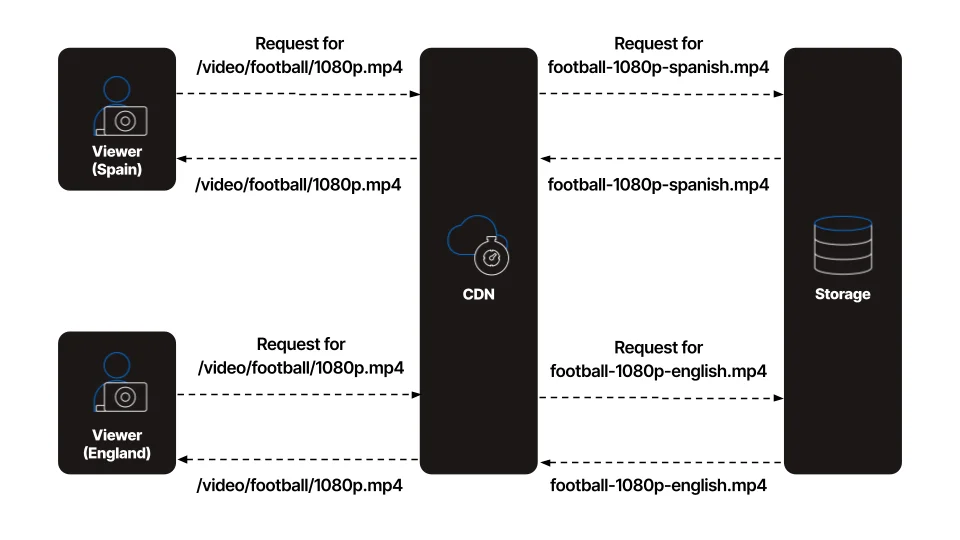
Adaptive bitrate streaming (ABR) gives a player a choice of video renditions, allowing it to adjust quality as network conditions change. That same mechanism can route suspected pirate viewers to a much worse version. The viewer-facing URL can still say 1080p, while a CDN rule rewrites the request to fetch a separate, extremely low quality rendition from the backend.

This works because a segment URL doesn’t have to map to the same stored file for every viewer. A provider might already route requests to different audio tracks based on a viewer’s country code, for example, though Fastly cautions against that particular implementation. More generally, the CDN can map an apparently ordinary request to a different rendition without changing the visible URL.
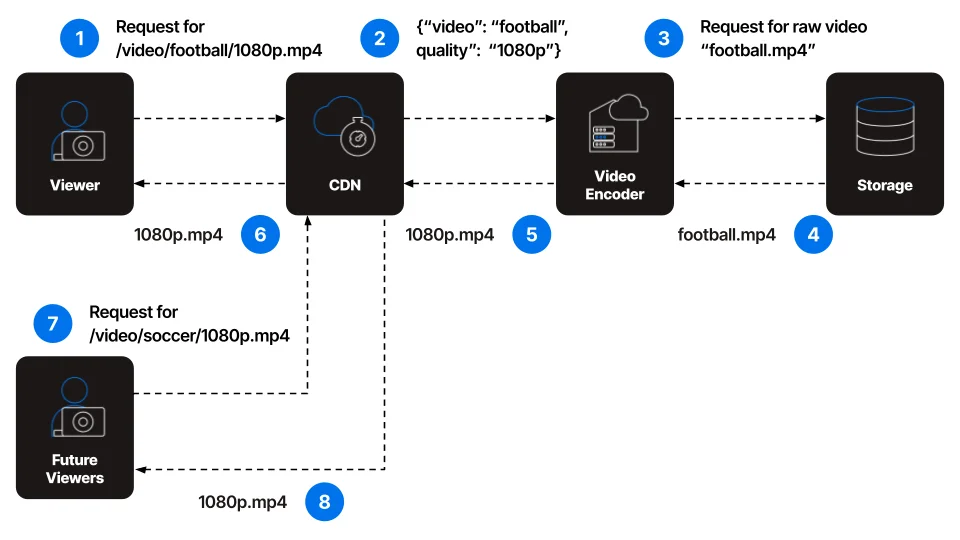
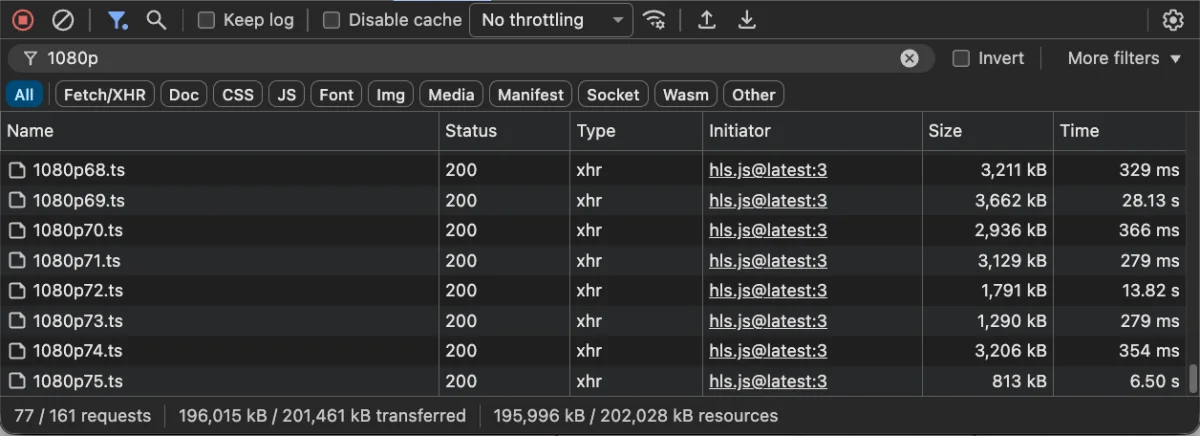
Fastly’s example uses ffmpeg to create a 1080p stream and a second rendition scaled to 60 pixels high at five frames per second, with a 20 kilobit per second video bitrate. A VCL rule then replaces “1080p” with “potato” in the backend request for traffic marked as piracy. This requires producing and making the extra rendition available, so teams need to account for the added encoding and storage work—or their existing transcoding setup—when weighing the option.
In Fastly’s demonstration, a 50/50 random condition stands in for actual detection, so roughly half the segments are degraded. The manifest itself remains the same for each viewer. The company says its examples run on live Fastly services and can change which segments are degraded without additional requests to the origin.
Alter the manifest at the edge
When adding renditions or changing the origin isn’t practical, Fastly says Fastly Edge Compute can modify HLS manifests at the CDN layer. One option is to use server guided ad insertion to redirect a player to an interstitial manifest. Another is to insert alternate segments directly into the playlist using HLS’s #EXT-X-DISCONTINUITY tag, which signals a change in encoding, resolution or timestamps.
For example, a playlist could play two four second segments from the event, insert three segments of different content, then return to the event after a second discontinuity. In that sequence, the viewer misses 12 seconds of the main stream. Alternate material might be a match between the same teams from the previous year, undercard fights in place of a boxing main event, or repeated pre-roll adverts. For audio services, it could be a different track by the same artist; that switch may take longer to notice when the stream is being scraped automatically.
Randomness may delay detection
Applying a penalty to every suspected viewer or every segment can make the change easy to identify. Fastly suggests varying the effect across segments, devices or regions, so different viewers encounter different problems. Combining slowdowns, degraded renditions and inserted material can further complicate efforts to diagnose the cause.
The tradeoff is operational: CDN rules need to distinguish pirate traffic reliably and apply the right treatment without disrupting legitimate playback. Random behaviour may make a penalty harder to trace, but it also makes diagnosis and measurement less straightforward. Providers will need to watch for effects on genuine viewers and see whether degraded pirate streams actually push audiences back to licensed services. The central idea is to make restreaming less dependable; the next question is whether teams can tune these controls without harming the experience they’re trying to protect.