Choosing a Current Sensor: AC, DC, In-Line and Non-Invasive Options
Compare eight current sensors by current type, measurement method, accuracy and interface to find the right fit for your circuit.
Choosing a current sensor starts with two practical questions: what kind of current are you measuring, and can the sensor sit in the circuit? SparkFun’s lineup spans clamp-based AC measurement, digital in-line monitors for DC and AC/DC, and analog boards that output a voltage or current. The right choice depends on the measurement range, interface and installation constraints; the headline accuracy alone doesn’t tell the whole story.
Current is the rate at which electrical charge moves through a circuit, measured in amperes. Voltage describes the difference in electrical potential between two points, while resistance describes how strongly a material opposes current. A water hose offers a useful analogy: flow rate resembles current, and pressure resembles voltage. Narrowing the hose reduces flow at the same pressure; increasing pressure can push more water through. In a circuit, voltage and resistance shape how much current flows.
One ampere corresponds to about 6.241 × 10¹⁸ electrons passing a point each second. For sensor selection, the more immediate distinction is whether the circuit carries alternating current (AC), direct current (DC), or either. Then consider whether you can break the circuit to insert a sensor, or need to measure current without disconnecting the wire.
Measure AC without opening the circuit
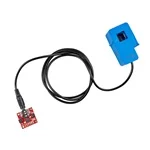
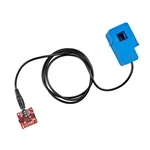
The ADE7953-based options are aimed at AC energy monitoring. A split-core current transformer clamps around a conductor, so the measurement can be made without cutting or splicing the wire. The kit includes that clamp, rated for 100 A to 50 mA, alongside a Qwiic-enabled ADE7953 metering IC. It communicates over I2C through Qwiic and also supports SPI and UART.
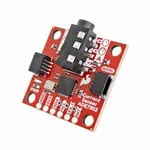
The standalone SparkFun Non-Invasive Current Sensor - ADE7953 (Qwiic) uses the same metering IC but does not include the clamp. That matters when comparing the two listings: the sensor board may suit a project that already has a compatible current transformer, while the kit packages the clamp and board together.
The ADE7953 measures active and reactive energy, and its second channel can measure neutral current. The source lists accuracy below 0.1% over a 3000:1 dynamic range and below 0.2% over 1000:1, with 1.24 kHz bandwidth. Those figures describe the metering device; a real setup also depends on the transformer and how the system is configured. For a project that needs AC power data without an in-line connection, this is the clearest fit in the lineup.
Digital in-line monitors for DC
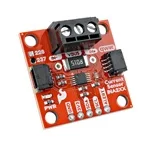
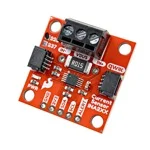
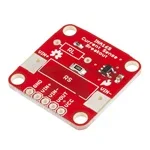
For DC circuits, the INA237 Qwiic Current Sensor measures current, bus voltage, temperature and power. Its 16-bit delta-sigma converter reads an in-line DC input through a 15 mΩ shunt resistor already fitted to the board. Through-hole pins allow a different shunt value to be installed, giving designers a way to adapt the measurement setup to their application.
The INA237’s listed accuracy is 1.6% of full scale, with bandwidth around 9 kHz; the actual bandwidth varies with ADC configuration. The key design tradeoff is that the shunt sits in the current path. That provides a direct measurement approach, but it means the board must be wired into the circuit.
The INA228 Qwiic Current Sensor shares the board’s physical design and measures current, voltage, power and temperature, while also tracking accumulated energy and charge. Its 20-bit delta-sigma converter is the main distinction from the INA237’s 16-bit converter. SparkFun lists 0.5% full-scale accuracy and roughly 9 kHz bandwidth, with bandwidth again dependent on ADC configuration. That higher-resolution measurement path makes the INA228 the more suitable option when tracking small changes matters; the source positions it for sensitive electronics.
Both boards use I2C over Qwiic and are designed for DC measurement. Their shared form factor may simplify a board-level design choice, but resolution and listed accuracy are only part of the decision: the required current range and selected shunt also matter.
One board for AC or DC, and analog alternatives
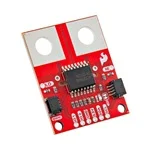
The ACS37800 Qwiic Power Meter is an in-line option for AC or DC. It measures voltage up to 60 VDC and current up to 30 A, and reports through I2C. SparkFun lists 1 kHz bandwidth and ±2% accuracy from 25°C to 125°C. Its stated range makes it a candidate for projects such as 3D printers, UAVs and solar panels, where simultaneous voltage and current monitoring is useful. The source doesn’t provide further installation details, so check the board documentation against your wiring and operating conditions.
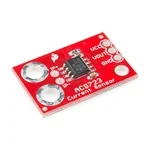
For systems where an analog signal suits the controller or data-acquisition setup, the ACS723 boards measure AC and DC current in-line. The standard ACS723 Current Sensor Breakout measures up to 5 A, with base sensitivity of 400 mV/A. Its listed accuracy is 1.5% at 25°C and bandwidth is 80 kHz.
The low-current ACS723 version is specified for currents from 10 mA to 5 A. It also uses a Hall-effect sensor, has 1.5% listed accuracy at 25°C and 80 kHz bandwidth, and outputs an analog signal. Both versions are in-line, but the low-current model is the more relevant starting point when the signal may be small. Confirm that its measurement range fits the expected load.
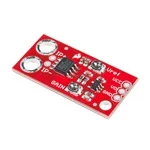
The INA169 Current Sensor Breakout uses a different analog approach. A shunt resistor sits on the positive supply rail, and the INA169 measures the voltage drop across it. The chip produces a small output current; adding a resistor from that output to ground converts it into a voltage that can be measured. SparkFun lists ±0.5% accuracy and 220 kHz bandwidth for AC/DC use. That makes the INA169 worth considering when a high-side shunt measurement and analog readout suit the circuit, though the shunt and output resistor become part of the design.
Match the sensor to the installation
For AC monitoring without breaking a conductor, start with the ADE7953 and choose between the board alone and the kit with its clamp. For in-line DC measurement, compare the INA237’s 16-bit converter with the INA228’s 20-bit converter and additional energy and charge tracking. If the project needs AC/DC measurement, weigh the ACS37800’s digital voltage and current readings against the ACS723’s analog output and current range. The INA169 offers another analog path based on a high-side shunt.
Interface, bandwidth and accuracy should be checked alongside the physical connection. A clamp can simplify installation, while in-line sensors require access to the circuit. Analog boards require the controller to read and interpret an analog signal; digital boards use their listed bus connections. For background on circuit behavior and power, see What is a Circuit?, Voltage, Current, Resistance, and Ohm’s Law, Electric Power and Alternating Current (AC) vs. Direct Current (DC). The useful next step is to check the sensor’s stated range and connection method against the actual circuit before choosing a board.