Orestes, Clytemnestra and the Art of the Oresteia
Aeschylus’ murder cycle turns family vengeance into tragedy, while later artists recast Orestes, Hermione and the Furies in paint and pottery.
Orestes’ story begins with a question that never stays settled: when he kills his mother, Clytemnestra, is he avenging his father or committing another crime in a family already shaped by murder? Aeschylus makes that conflict the engine of the Oresteia, a trilogy that follows the killings from Agamemnon’s return from Troy to the Furies’ pursuit of his son. Later Greek and European artists found different moments in the same tangled mythology, often emphasizing desire, grief or the price of vengeance.
The myth survives in plays by Aeschylus, Sophocles and Euripides, whose versions differ. Aeschylus’ three-play cycle appears to have supplied a particularly influential account for artists. The broader family history, however, reaches well beyond that trilogy and includes the troubled marriage of Orestes and Hermione.
A family divided by war and marriage
Helen, whose abduction helped set the Trojan War in motion, was the daughter of Leda and Tyndareus, king of Sparta. She married Menelaus, who succeeded Tyndareus, and they had a daughter, Hermione. After Paris—also called Alexander—took Helen to Troy, Menelaus joined the Greek forces there. Hermione remained in Sparta under her grandfather’s care.
In one strand of the story, Tyndareus arranged for Hermione to marry her cousin Orestes, son of Agamemnon and Menelaus’ brother. By the war’s end, the two may already have been living together. Menelaus nevertheless promised Hermione to Pyrrhus, also known as Neoptolemus, the son of Achilles. After the Greeks returned, Menelaus enforced that match, taking Hermione from Orestes.
Pyrrhus had brought Andromache back from Troy as a concubine. She had been the wife of Hector, whom Achilles killed, and mother of Astyanax. Accounts disagree about the boy’s fate: some say Pyrrhus threw him from Troy’s walls during the city’s sack; others, including Euripides, say he survived and came with his mother. The uncertainty matters in later depictions, where the child’s presence can turn a domestic rivalry into a reminder of Troy’s violence.
Hermione and Andromache became bitter enemies. Hermione blamed Andromache’s supposed sorcery for her inability to conceive a child with Pyrrhus, while Andromache mocked her childlessness. Hermione began plotting to kill her rival, and, in some versions, Astyanax as well. Orestes then visited Hermione, and they eloped. He set out to kill Pyrrhus, whose death would free her from the unwanted marriage. Some accounts make Orestes the killer; others say Pyrrhus died at Delphi after desecrating its sanctuary. Hermione was then able to marry Orestes.
The violence returns to Mycenae
Orestes’ family history offers no clean escape from vengeance. On returning to Mycenae, Agamemnon found that Clytemnestra had taken Aegisthus, his cousin, as her lover. The pair killed Agamemnon and took power, though accounts differ about which of them struck the fatal blow. In Aeschylus’ version, Clytemnestra and Aegisthus’ motive also reaches back to Agamemnon’s sacrifice of their daughter Iphigenia, made to secure favorable winds before the fleet sailed for Troy.
Years later, Orestes returned to avenge his father. In the wider family tradition, he killed Clytemnestra, Aegisthus and their daughter Helen. He went back to Sparta, where he and Hermione had a son, Tisamenos. Hermione later disappears from the story, while Orestes eventually returned to Mycenae. He killed Aletes, the surviving son of Clytemnestra and Aegisthus, married his half-sister Erigone and took the throne.
Aeschylus strips this history into a tightly linked sequence. In Agamemnon, the returning king is murdered by Clytemnestra and Aegisthus; Cassandra, his concubine, is killed too. In The Libation Bearers, Orestes comes home and kills both his mother and her lover. The final play, The Eumenides, opens with the Furies hunting him for matricide, tormenting him in pursuit of punishment.
The trilogy won first prize at the Dionysia festival in 458 BCE. Its afterlife includes Eugene O’Neill’s Mourning Becomes Electra and Jean-Paul Sartre’s The Flies, alongside many painted scenes on ancient pottery. The stories became less prominent as subjects for Renaissance art. Among the earliest post-classical works located by the source is an image of Orestes and the Furies from the late eighteenth century—roughly two millennia after the ancient pots.
Artists choose their moments

Girodet’s drawing, made around 1800 as part of a series illustrating Racine’s play, catches Orestes approaching Hermione. She stands at the right with folded arms; a second woman, likely her maid, accompanies him. The small details shift the scene’s mood. A table support visible between the figures takes the form of a siren rather than a Fury, suggesting that Hermione is drawing Orestes in. Her slipped shoulder strap reinforces the reading of her as a femme fatale, a role associated here with Euripides and Racine.

Guérin’s Andromache and Pyrrhus (1810) places Pyrrhus on a throne and Andromache kneeling beside him, holding a child. Two other women face them. The woman at the right is likely Hermione, visually displaced from her imposed position as Pyrrhus’ wife. The child is probably Astyanax, whose uncertain fate is part of the scene’s tension: in one account he died at Troy, while in another he lived long enough to be taken with Andromache. Hermione’s plot against Andromache could also include the boy.

In Guérin’s companion scene, Orestes Announces the Death of Pyrrhus to Hermione (around 1810), Orestes displays the sword used to kill Pyrrhus at Delphi. Hermione recoils, as does the maid behind her. The painting draws on a later episode told by Euripides and Racine, making the murder both a release from Hermione’s enforced marriage and another link in Orestes’ chain of violence.
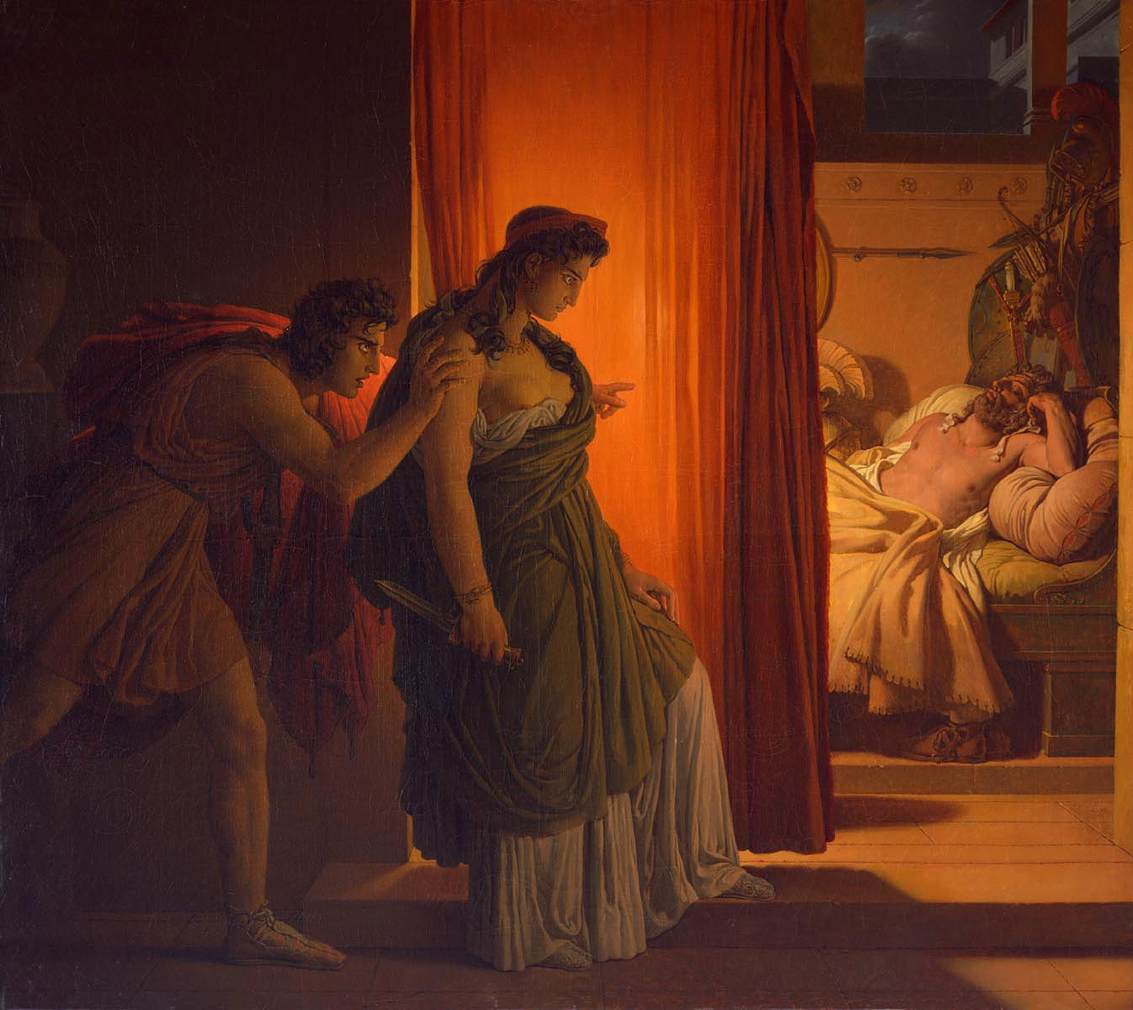
Guérin’s 1817 painting turns to an earlier murder. In Clytemnestra hesitates before killing the sleeping Agamemnon, she stands over her husband with a short sword as he lies in bed. The subject, drawn in part from Aeschylus, makes the family’s cycle plain: Orestes’ later act of revenge answers a killing that was itself shaped by an earlier sacrifice.
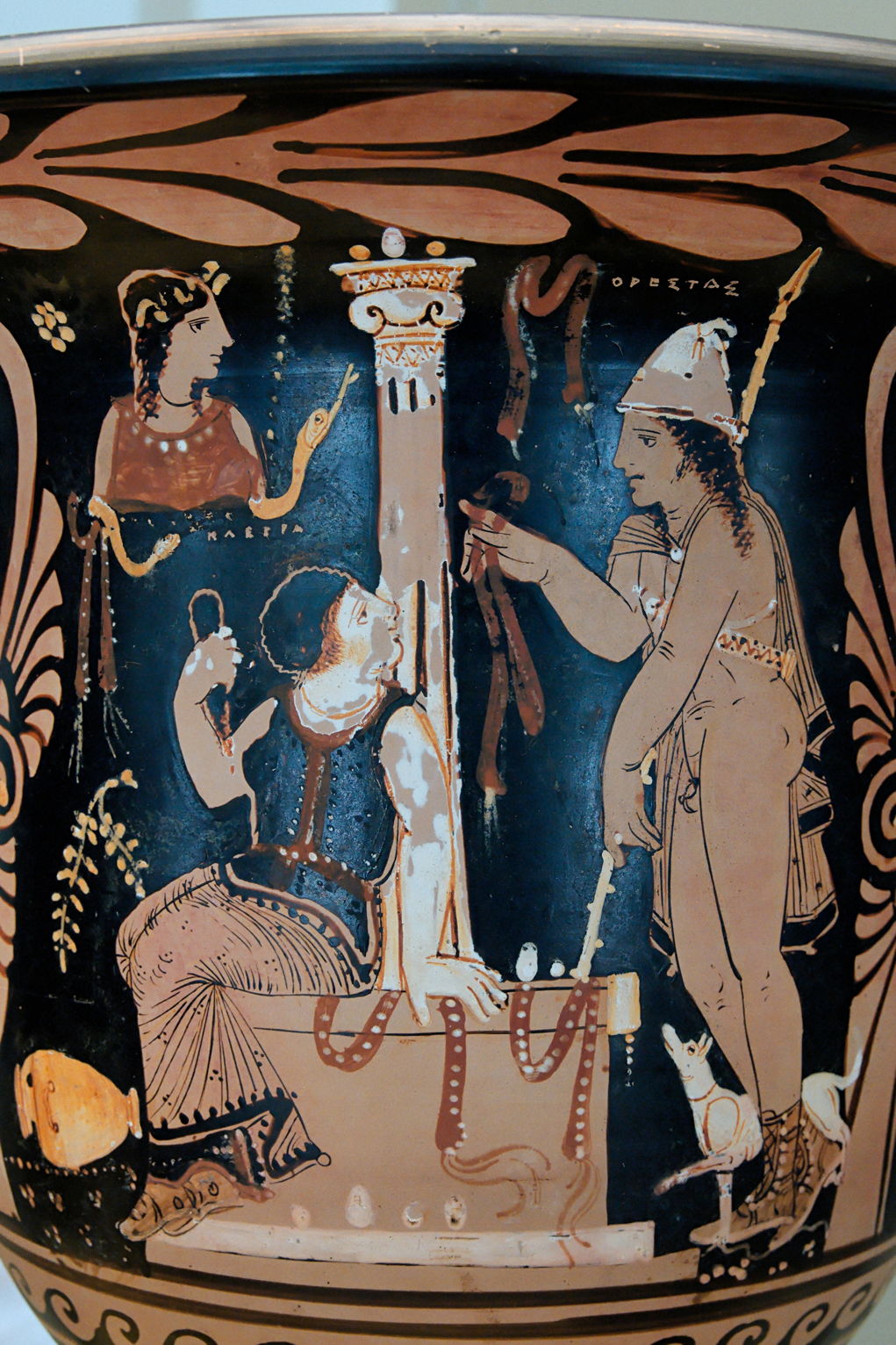
An ancient red-figure vessel, dated 340–330 BCE, shows Orestes meeting his sister Electra at Agamemnon’s tomb. The scene remained a durable subject for later painters.
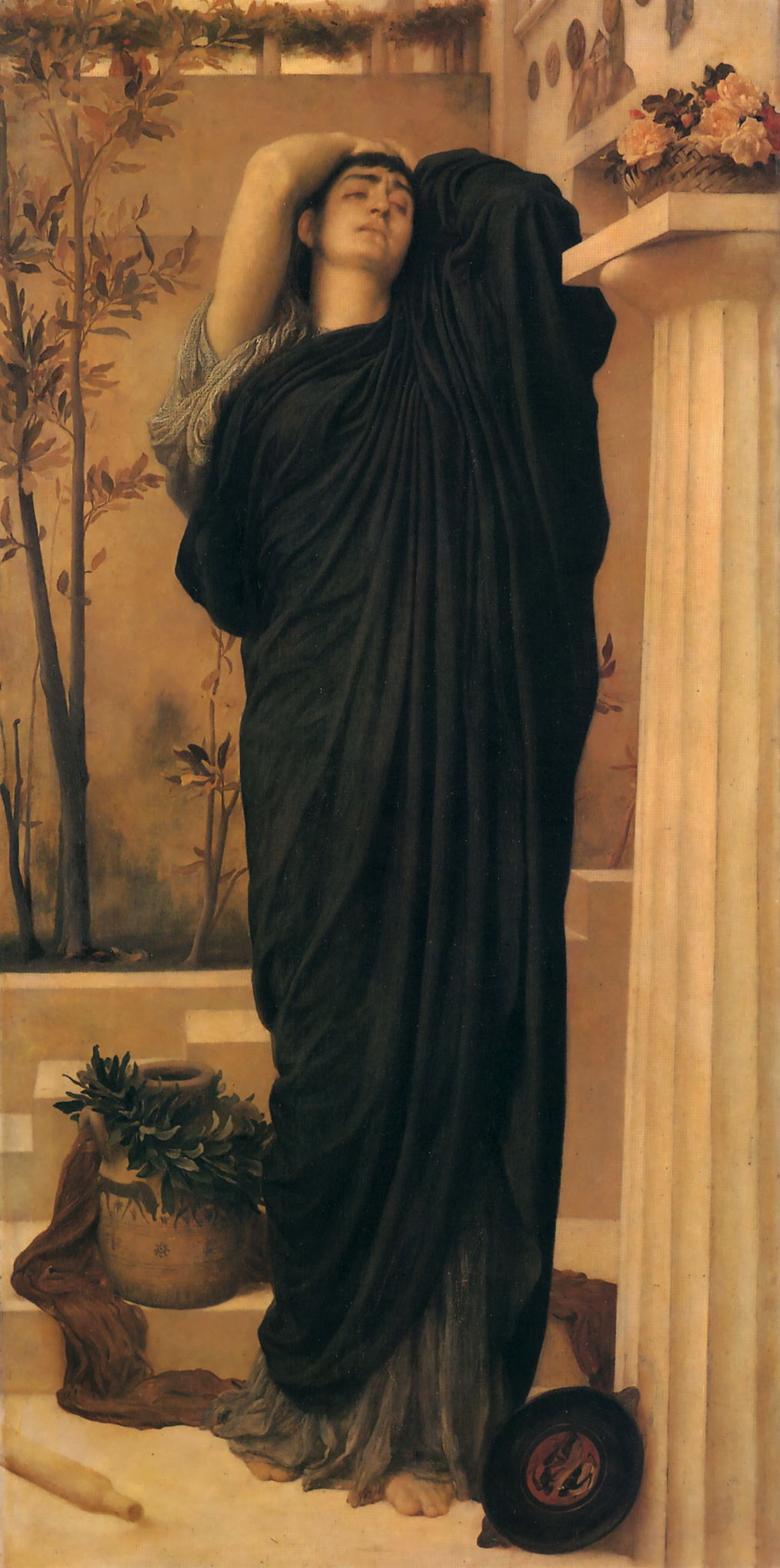
Frederic, Lord Leighton’s Electra at the Tomb of Agamemnon (1868–69) replaces the encounter with solitary grief. Electra wears black beside a substantial tomb, her eyes closed and her brow tightened. She presses her hands to the top of her head in a gesture associated with tearing one’s hair.

A drawing of an undated krater in Naples shows Orestes seeking sanctuary at Delphi, with a black Fury at the upper left pointing a snake toward the figures. The image makes the pursuit visible: after the murders, Orestes cannot simply return to ordinary life.
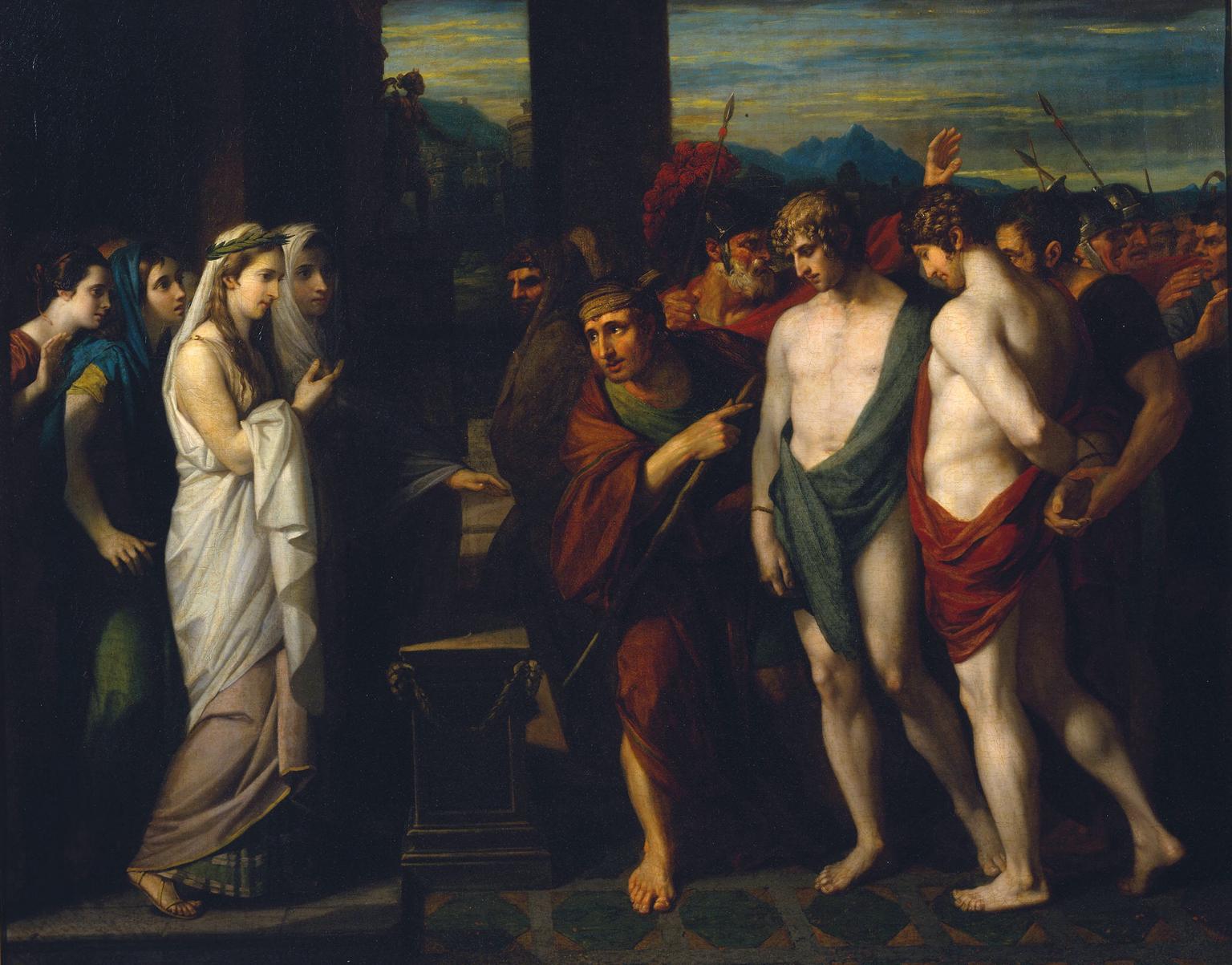
Benjamin West’s 1766 painting brings Orestes and his cousin Pylades before Iphigenia, who serves as a priestess of Diana. After killing his mother, Orestes was instructed by the Delphi oracle to return Diana’s gold statue. His attempt to take it placed him in danger of sacrilege; West shows the two men facing sacrifice at the altar between them and the priestess.

On an Apulian red-figure vessel from 380–370 BCE, Orestes still grips his sword as Apollo purifies him. At the far left, Clytemnestra tries to wake the sleeping Furies. The scene points toward the trilogy’s unresolved pressure: purification may mark a path forward, but the Furies are already there, waiting to confront the son who killed his mother.